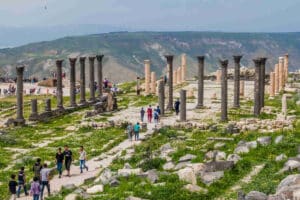
The Umm Qais Roman Aqueduct Experience is one of the four tourist experiences organized by the Jordan Heritage Revival Company. As we have mentioned in this blog,
Umm Qais: the Ancient Gadara of the Roman Decapolis
Umm Qais is a small city in northern Jordan that is currently known for its Roman archaeological remains: it was the ancient city of Gadara, which was part of the Decapolis (group of ten cities on the eastern border of the empire, allied by sharing the same culture).
Among the many interesting elements that are preserved from that period, what has been called the “aqueduct” stands out: it is a system used, effectively, to transport water between the aforementioned cities and that had an approximate length of 170 km.
In reality, it was not an aqueduct in the traditional sense, understood as a canal that runs over raised arches. It was, in reality, a
It was, therefore, a system more similar to the Persian qanats, which was later also used by the Arab civilization in places as varied as Marrakech, Córdoba or Madrid, where they are called “water journeys.”
All this under the extraordinary archaeological site, where you can still admire standing housing structures, columned avenues, a theater and many other enclosures that take us back to the Roman period, but also to the later Byzantine period, with remains of Christian churches.
What the Experience Consists Of
The JHRC experience, which is called Gadara Aqueduct Experience, is not a theatrical show like the Wadi Rum train adventure, but rather a guided tour that explains to visitors the high historical value of this hydraulic device that is about two millennia old.
To begin with, an explanatory video of about 10 minutes is shown, which tells the context of said aqueduct: what the Decapolis was and what place Gadara occupied in it. After that, the experience leads to the
And it is that the Roman civilization was really obsessed with water, because it knew that this was fundamental for the sustainability of its cities and, ultimately, of its vast empire.
Therefore, although these qanats or underground aqueducts no longer transport water, their visit is really interesting to understand how ancient civilizations managed to enjoy quality running water, with the limited means they had available 2,000 years ago.
To join this experience, it is advisable to consult the conditions of the JHRC, but the usual thing is that it takes place seven days a week, from 8:00 a.m. to 4:00 p.m. (closed at noon on Fridays). In addition, in the winter season and on days with a forecast of rain, the tunnel closes, which shows its capacity to collect water from rainfall.